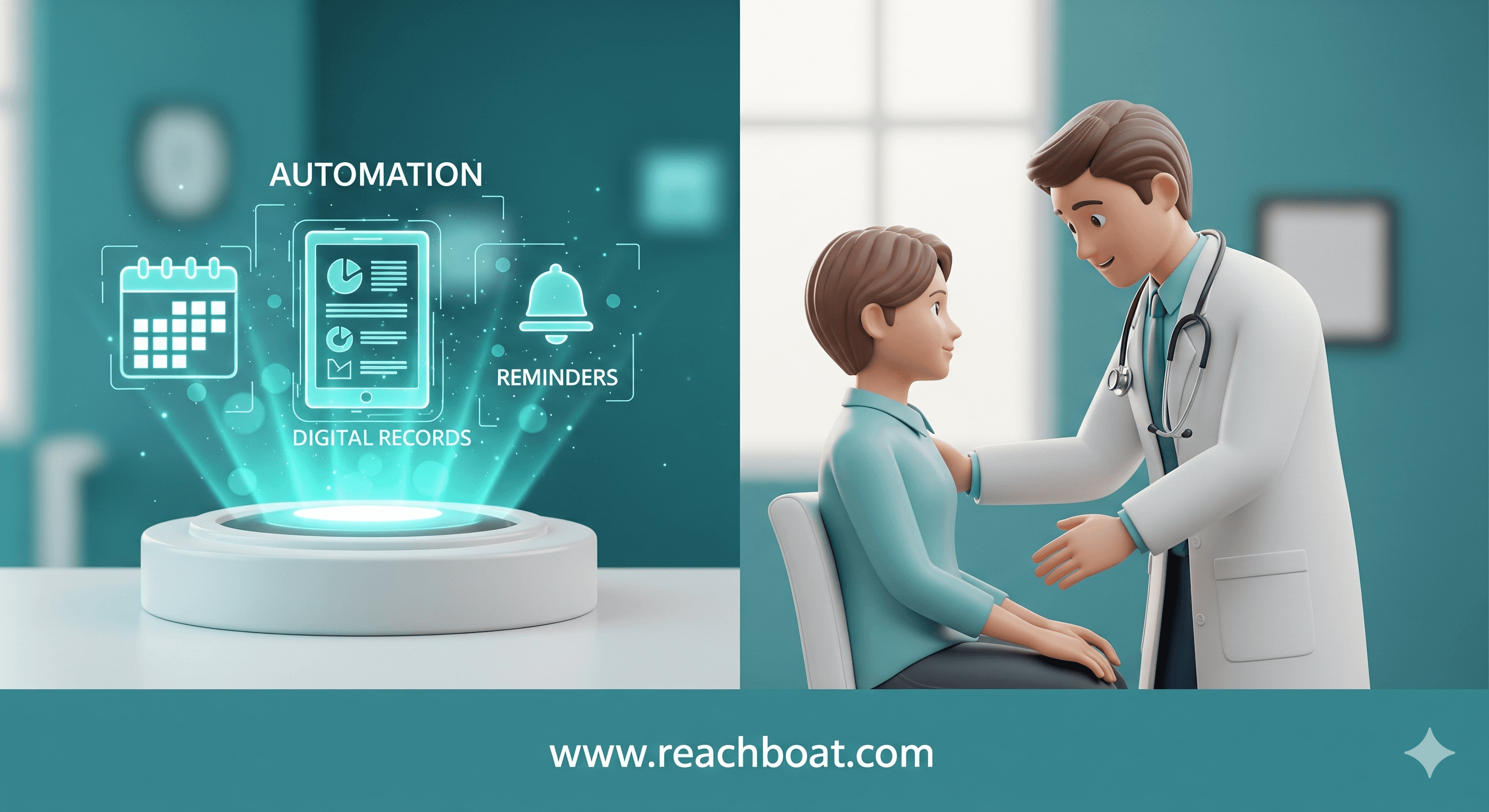
Automation in healthcare often creates mixed reactions.
Some clinics over-automate and lose the human touch.
Others avoid automation entirely and remain overwhelmed by daily tasks.
The truth lies somewhere in between.
The goal of clinic automation is not to replace people.
It is to reduce friction, limit interruptions, and protect clinical focus.
Why Clinics Consider Automation
Most clinics face similar challenges:
Repeated phone calls for basic questions
Missed or late appointment confirmations
No-shows despite reminders
Staff time spent on routine coordination
Automation becomes necessary when these tasks start consuming time that should be spent on patient care.
What Clinics Should Automate First
Automation works best when applied to predictable, repetitive, and low-risk tasks.
The following areas are ideal starting points.
Appointment Scheduling and Confirmations
Automated booking and confirmation systems reduce back-and-forth communication and prevent errors. Patients get clarity instantly, and staff workload drops significantly.
Reminders and Follow-Ups
Automated reminders help reduce no-shows and forgotten appointments. Follow-ups ensure continuity without manual tracking.
Basic Patient Inquiries
Routine questions about timings, location, services, and preparation can be handled automatically without affecting care quality.
Review and Feedback Collection
Automated prompts after visits help clinics gather feedback consistently without awkward follow-up calls.
What Should Not Be Automated
Not everything benefits from automation.
Some interactions must remain human to preserve trust and empathy.
Medical Advice and Diagnosis
Clinical decisions should always involve direct doctor-patient interaction. Automation should support care, not deliver it.
Sensitive Conversations
Discussions involving complex conditions, emotional concerns, or treatment decisions require human presence and judgment.
Complex Patient Queries
When a patient’s question goes beyond standard information, human response builds reassurance and clarity.
Automation should never replace clinical responsibility.
Why Over-Automation Creates Problems
Some clinics automate too aggressively, leading to:
Patients feeling unheard
Loss of personal connection
Confusion during complex situations
Good automation is subtle.
Patients should feel supported, not processed.
The Right Way to Think About Automation
Automation should act like infrastructure, not a spotlight.
When done correctly:
Patients experience smoother interactions
Staff experience fewer interruptions
Doctors regain focus on care
The system works quietly in the background.
How Automation Supports Clinic Growth
Clinics that automate correctly often see:
Better appointment adherence
Improved patient satisfaction
Reduced administrative load
More predictable daily operations
This creates space for growth without increasing stress.
Automation Is a Design Choice, Not a Technology Choice
The success of automation depends less on tools and more on intent.
Ask:
Does this reduce friction?
Does it protect patient trust?
Does it simplify daily operations?
If the answer is yes, automation is likely appropriate.
Simplicity Over Sophistication
The best clinic automation systems are rarely complex.
They are clear, reliable, and consistent.
When automation respects boundaries, it strengthens care instead of distancing it.
FAQ
Questions Doctors Ask Before Partnering with Reachboat
Clear answers to help you decide with confidence.
I’m not tech-savvy at all. Will I need to manage anything?
How quickly can I expect to see results?
Do I need to create content or be active on social media?
Will this work for my specialty or my city?
What exactly is AI visibility (GEO), and why does it matter?
Is my patient data secure? What about compliance?
FAQ
Questions Doctors Ask Before Partnering with Reachboat
Clear answers to help you decide with confidence.
I’m not tech-savvy at all. Will I need to manage anything?
How quickly can I expect to see results?
Do I need to create content or be active on social media?
Will this work for my specialty or my city?
What exactly is AI visibility (GEO), and why does it matter?
Is my patient data secure? What about compliance?
FAQ
Questions Doctors Ask Before Partnering with Reachboat
Clear answers to help you decide with confidence.
I’m not tech-savvy at all. Will I need to manage anything?
How quickly can I expect to see results?
Do I need to create content or be active on social media?
Will this work for my specialty or my city?
What exactly is AI visibility (GEO), and why does it matter?
Is my patient data secure? What about compliance?
Digital Practice Transformation for Modern Doctors
Built for healthcare professionals. Privacy-first. Compliance-aware.

Digital Practice Transformation for Modern Doctors
Built for healthcare professionals. Privacy-first. Compliance-aware.
Digital Practice Transformation for Modern Doctors
Built for healthcare professionals. Privacy-first. Compliance-aware.