I Spent 3 Months Visiting Clinics Across Delhi NCR. Here Is What Doctors Actually Think About AI.
Pediatrics
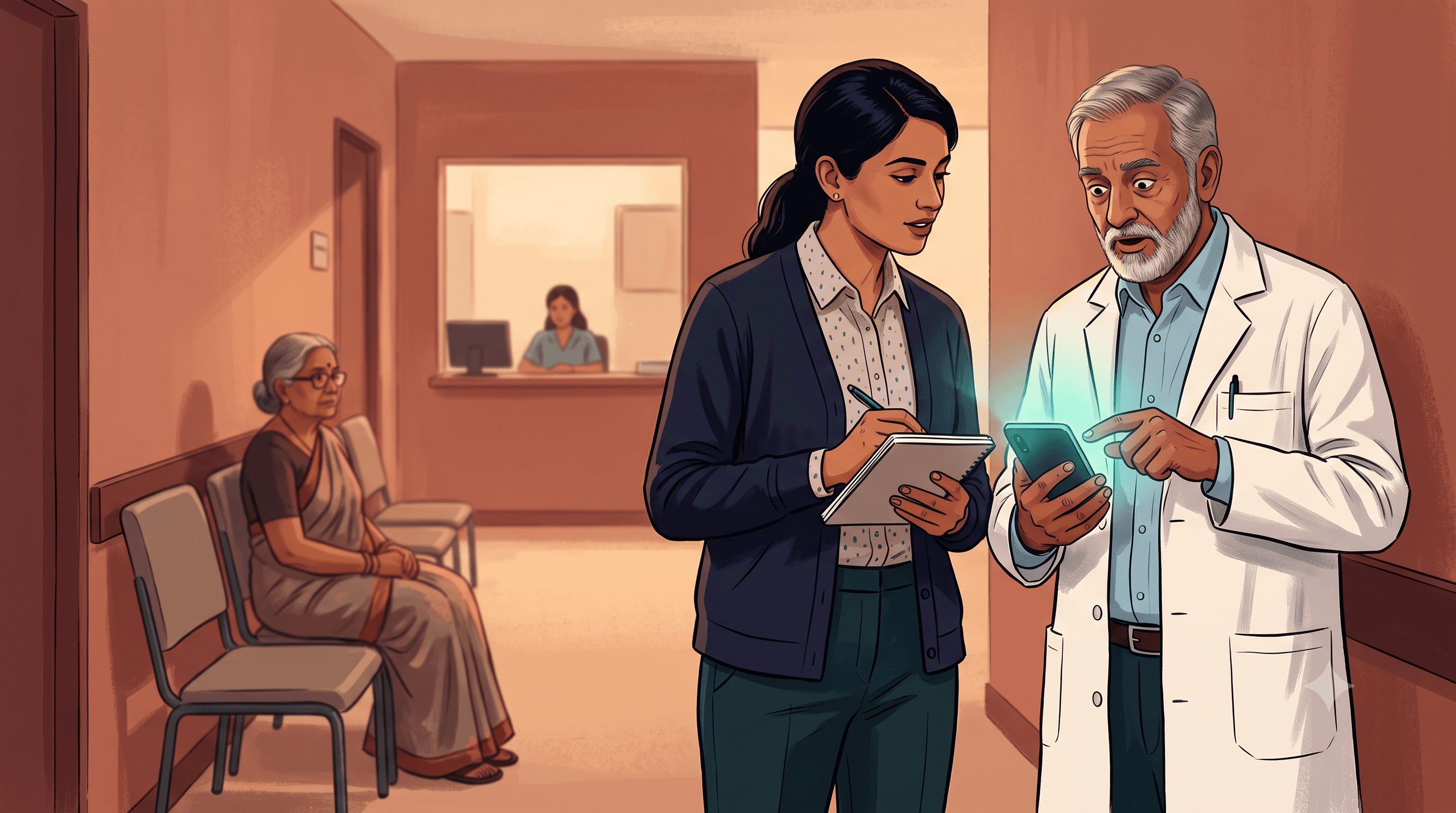
I Did Not Go Looking for a Story. The Story Was Already in Every Waiting Room.
Over the last three months I visited private clinics across Noida, Indirapuram, Dwarka, and Gurugram. Not as a patient. As someone who works with doctors on their digital presence, and who had started noticing a gap so wide between what the industry headlines were saying about AI and what was actually happening inside these consultation rooms that I felt the need to document it properly.
I spoke with gynaecologists, paediatricians, dermatologists, orthopaedic surgeons, and general physicians. Senior practitioners with two decades of practice. Junior doctors who had opened their own clinic within the last three years. Doctors attached to hospital systems. Doctors running fully independent practices out of rented clinic space.
What I found was not what the conference talks and LinkedIn posts about AI in healthcare would suggest. It was more human, more uneven, and in some ways more urgent than any stat I had read in a report.
Here is what the ground actually looks like.

The First Reaction. Every Single Time.
I learned early to stop leading with the word "AI." The moment you say it in a clinic context, a shutter comes down. The doctor hears something between a sales pitch and a science fiction plot. So I stopped saying it first and started asking a question instead.
"When a patient in your area searches for a doctor like you on their phone tonight, where do you think they look?"
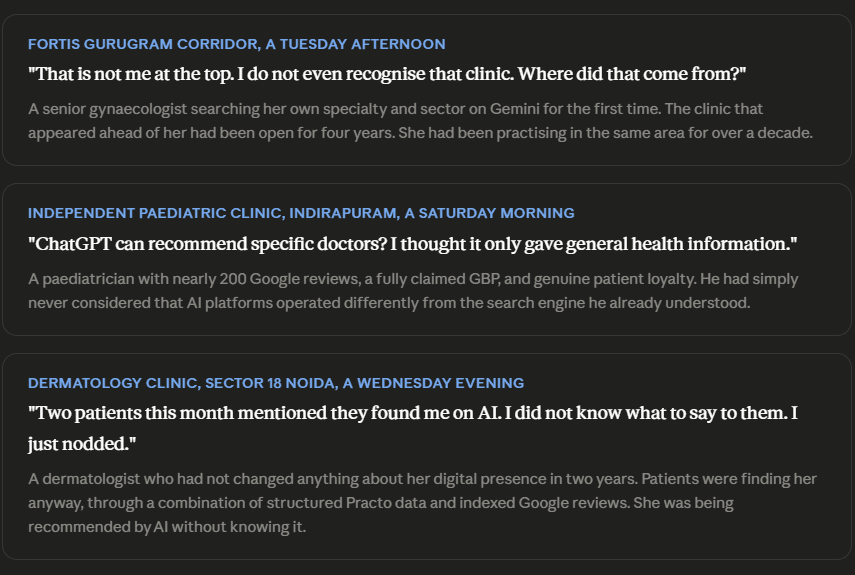
The answer, almost universally, across all specialties, across all geographies within NCR, was a variation of the same sentence. "My patients come through referrals. Word of mouth. People who know me." A senior gynaecologist I met near Fortis Gurugram said it with complete conviction. She has been practising for over eighteen years. Her clinic runs full. Her reputation in her catchment area is genuinely strong. She was not wrong about her current situation. She was wrong about what was quietly building around it.
Then I would ask a second question. "Would you mind opening Google or Gemini right now and searching for your specialty and your area?"
That second question is where the conversation always changed.
How Patient Search Has Actually Changed
The shift in how patients search for doctors is not a future event. It has already happened, and it happened faster than almost anyone in Indian private practice tracked.
Three years ago, a patient looking for a specialist would type something like "skin doctor near me" into Google and scroll through a list of links. Today, that same patient is more likely to open Gemini or ChatGPT and type something that reads like a conversation: "Which dermatologist in Noida is good for adult acne and does not rush consultations?" They are not looking for a list. They are looking for a recommendation. And AI gives them exactly that.
The query has changed from a keyword to a question. The answer has changed from ten blue links to a single paragraph of confident, specific guidance. A scoping review published in March 2026 concluded that ChatGPT consistently outperforms Google Search in factual accuracy for health queries. Consumers' reliance on AI to choose a healthcare provider has more than doubled in a single year, from 17 percent to 36 percent. And the demographic driving this shift is not who most doctors expect. More 45 to 60 year olds, at 64 percent, are actively using AI to find doctors than any other age group. The patients who built their loyalty to their current doctors over years of word of mouth and referral are now the ones most likely to cross-reference those referrals with an AI query before they book.
Google's own data adds another layer to this. AI Overviews now appear on 88 percent of all healthcare queries. This means that even the patients who are not deliberately using ChatGPT are encountering AI-generated answers every time they search for anything health-related on Google. The patient who types "gynaecologist Dwarka" into the Google search bar on their phone is now receiving an AI-generated summary at the top of the page before they see a single clinic listing. If a doctor's profile does not feed into that summary, they are invisible before the patient even begins to scroll.
The query has changed from a keyword to a question. The answer has changed from ten blue links to a single paragraph of confident, specific guidance. The doctor who does not appear in that paragraph is not losing to a competitor. They are losing to a gap in their own digital presence.
The Doctors Who Are Already Seeing It
Not every clinic I visited was unaware. A small but notable group of doctors across NCR have started noticing something different in their patient intake patterns over the last eight to twelve months. They cannot always explain exactly why it is happening, but the signal is consistent enough that they have started paying attention to it.
A fertility specialist I met near Motherhood Gurgaon described it precisely. She said that patients were arriving at their first consultation already knowing things about her approach that were not on any poster in her waiting room. They had read something online. They had been told by an AI that she was good with a particular condition. Some had done more research on her in the 24 hours before the appointment than her referral patients had done in years of knowing her name through word of mouth.
What she found uncomfortable was not that patients were arriving informed. It was that some of those same patients, equally informed, had mentioned another specialist they had also spoken with first. A doctor she had never heard of, based nearby, who kept appearing in AI answers whenever her specialty and area were searched. She had more experience. She had more reviews. She had been in that catchment area longer. But in the AI's world, she and that doctor were being evaluated on a completely different set of signals than the ones that had built her reputation over a decade.
This is the part of the AI visibility conversation that most doctors find genuinely unsettling when they hear it for the first time. It is not about replacing expertise. It is about the fact that expertise is now invisible until it is documented, structured, and made legible to systems that operate on data rather than reputation.
The Part Nobody Talks About: What Happens After They Find You
Every conversation I had about AI visibility eventually led to a second conversation that most clinic owners had never had at all. Even the doctors who were beginning to understand that patients were finding them differently had not yet connected that shift to what patients now expected once they arrived at the booking stage.
A patient who found a doctor through an AI recommendation in 2026 did not arrive at that recommendation through a passive experience. They typed a question, received a confident answer, possibly asked two or three follow-up questions to the same AI, and made a decision within minutes. The entire pre-booking journey was fast, frictionless, and conversational. Then they called the clinic. And in the majority of clinics I visited, they were either put on hold, told to call back during morning hours, or connected to a receptionist who took their name and said someone would confirm the appointment.
The gap between those two experiences, the AI-native discovery and the 2012-era booking process, is where patients are being lost without anyone in the clinic knowing it happened.
India has over 600 million WhatsApp users and more than 12 lakh registered doctors, yet most clinics still rely on phone calls, handwritten appointment books, and manual SMS reminders. Across Indian clinics audited across 47 specialist practices in late 2025, the average no-show rate for booked appointments was 19.4 percent, with the worst quartile above 26 percent. Every missed appointment costs an Indian clinic between 800 and 2,500 rupees in lost consultation revenue, not counting the follow-up treatments and diagnostics that never happen as a result.
The solution is not complicated. Multi-touch reminder sequences have been shown to reduce no-show rates by 30 to 50 percent in healthcare settings. Appointments booked online have a 1.8 percent no-show rate compared to 5.9 percent for offline bookings. WhatsApp automation that confirms the appointment, sends preparation instructions the day before, and follows up after the visit is not a luxury feature. It is the minimum that a patient who found you through AI now expects, even if they cannot articulate it in those terms. They just know that the experience felt either smooth or not. And smooth is the baseline that AI-era discovery has set.
What I Think Is Actually Happening
After three months of these conversations, what strikes me most is not the resistance. The resistance is understandable. Doctors in India built their practices through relationships, trust, and clinical excellence, and they are reasonably sceptical of anyone who walks in suggesting that a technology platform is about to upend something that took them twenty years to build.
What strikes me is the unevenness. In the same specialty, in the same micro-market, within a two-kilometre radius of each other, you can find one doctor who is beginning to appear in AI recommendations and receiving patients who arrive pre-informed and pre-convinced, and another doctor of equal or greater skill whose digital presence is so thin that AI systems have nothing to work with. Both doctors are working the same hours. Both are producing the same quality of care. The difference between them is entirely in the data layer, not the clinical one.
And the patient journey piece is the one that I believe will become undeniable in the next twelve months. The doctors who get found through AI and then run a frictionless, automated booking and follow-up experience will retain patients at a meaningfully higher rate than those who get found and then lose them at the confirmation stage. The practices that measure their no-show rate, automate their reminder cadence, and follow up post-visit will compound the advantage that AI visibility creates. The ones that do not will keep assuming the problem is awareness when the problem is actually attrition.
The gynaecologist near Fortis Gurugram asked me something as I was leaving that has stayed with me. After the silence that followed searching for her own name on Gemini, she looked up and said: "So what do I actually do about this?"
That question is the most honest thing I heard in three months. And it is exactly the right place to start.
FAQ
Questions Doctors Ask Before Partnering with Reachboat
Clear answers to help you decide with confidence.
I’m not tech-savvy at all. Will I need to manage anything?
How quickly can I expect to see results?
Do I need to create content or be active on social media?
Will this work for my specialty or my city?
What exactly is AI visibility (GEO), and why does it matter?
Is my patient data secure? What about compliance?
FAQ
Questions Doctors Ask Before Partnering with Reachboat
Clear answers to help you decide with confidence.
I’m not tech-savvy at all. Will I need to manage anything?
How quickly can I expect to see results?
Do I need to create content or be active on social media?
Will this work for my specialty or my city?
What exactly is AI visibility (GEO), and why does it matter?
Is my patient data secure? What about compliance?
FAQ
Questions Doctors Ask Before Partnering with Reachboat
Clear answers to help you decide with confidence.
I’m not tech-savvy at all. Will I need to manage anything?
How quickly can I expect to see results?
Do I need to create content or be active on social media?
Will this work for my specialty or my city?
What exactly is AI visibility (GEO), and why does it matter?
Is my patient data secure? What about compliance?
Digital Practice Transformation for Modern Doctors
Built for healthcare professionals. Privacy-first. Compliance-aware.

Digital Practice Transformation for Modern Doctors
Built for healthcare professionals. Privacy-first. Compliance-aware.
Digital Practice Transformation for Modern Doctors
Built for healthcare professionals. Privacy-first. Compliance-aware.