The Telemedicine Value Collapse: How COVID-Era Pricing Is Still Haunting Indian Private Practice
Pediatrics
A Market Built On Emergency Terms
India's telemedicine market was valued at USD 4.15 billion in 2025 and is projected to reach USD 19.5 billion by 2035, expanding at a CAGR of 16.73%. Eclincher By every conventional measure, the sector is thriving.
But beneath the growth figures lies an unresolved structural problem that the industry has not confronted honestly since the pandemic ended.
During COVID-19, India's private practitioners made a rational decision under irrational circumstances. With clinics shut, footfall eliminated, and operational costs unchanged, doctors migrated to telemedicine platforms at whatever price the market would bear. Telemedicine offers a cost-effective solution, often reducing consultation fees by up to 30% compared to in-person visits. Connectsafely In 2020 and 2021, that discount was not a business strategy. It was a survival mechanism.
The crisis passed. The pricing architecture did not.
The Price Anchor Problem
Behavioural economics has a well-documented concept called price anchoring, the tendency for consumers to rely heavily on the first price they encounter when making subsequent purchasing decisions. India's telemedicine boom embedded a price anchor across an entire patient generation.
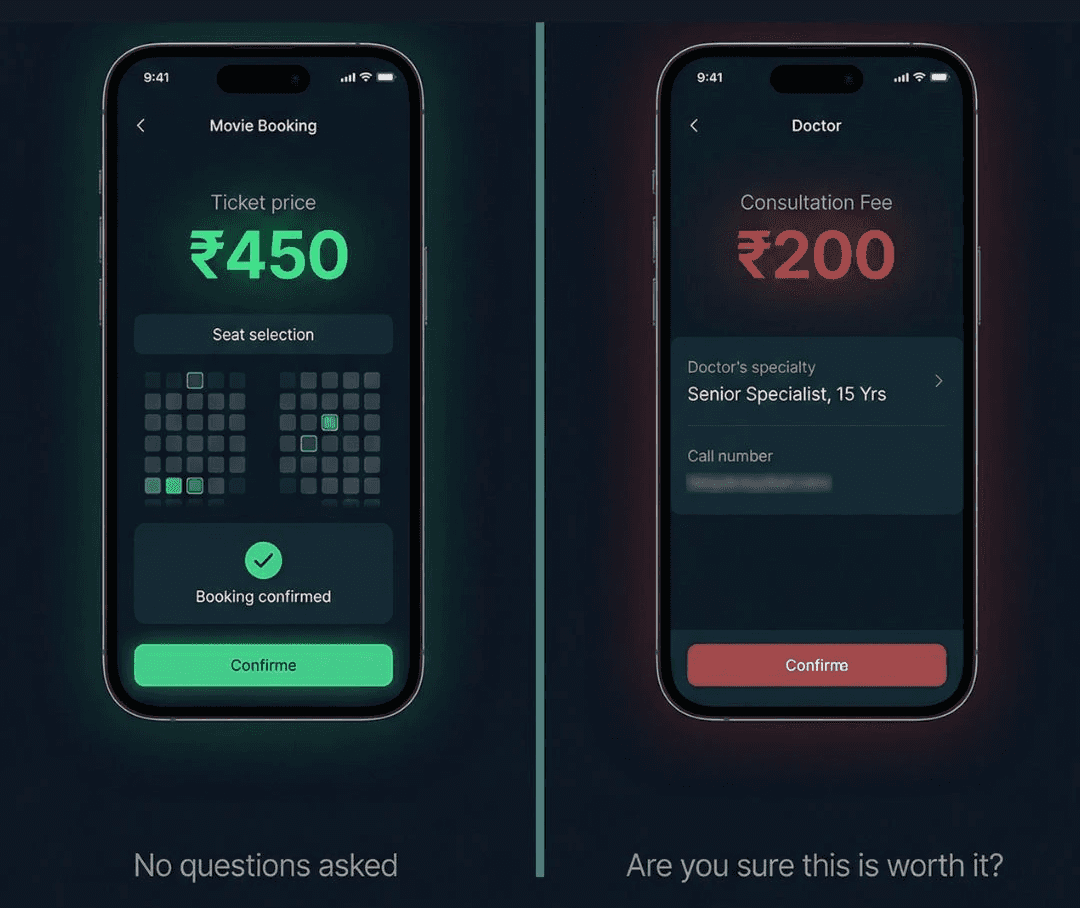
A patient who received specialist consultation for ₹200 to ₹500 during lockdown does not recalibrate that expectation when the lockdown ends. They carry it into every booking decision in 2026. When the same specialist charges ₹1,500 for a clinic visit, the perceived gap is not evaluated against the clinical value delivered , it is evaluated against the digital price they remember.
This is not patient irrationality. It is the entirely predictable consequence of emergency pricing becoming the market baseline.
The Expertise Commodification Effect
The structural design of telemedicine platforms compounded the problem further. When a senior cardiologist and a general practitioner appear side by side on the same interface, differentiated primarily by price and availability, the platform architecture communicates something unintended: that medical expertise exists on a spectrum of product options, not a hierarchy of clinical competence.
Approximately 70% of patients favour telemedicine for its convenience. Connectsafely Convenience, by definition, is a commodity attribute. When healthcare is selected primarily on convenience grounds speed, accessibility, price the clinical depth behind the consultation becomes invisible in the transaction.
The result is a market where a decade of specialist training competes directly with a general practitioner on price per minute, on the same screen, with no mechanism for the patient to evaluate the difference.
The Negotiation That Never Happened
Perhaps the most consequential aspect of this problem is what did not occur after the emergency ended.
Individual doctors who dropped their fees to survive made rational decisions in an irrational moment. The collective result of thousands of those decisions was an industry-wide devaluation that no single practitioner caused and no single practitioner can reverse in isolation.
Private hospitals and clinics captured 55.05% of telemedicine market demand in 2025. Closely Corporate healthcare providers, with their marketing infrastructure and brand equity, have navigated this pricing environment more effectively than private practitioners precisely because they had the institutional leverage to maintain price positioning.
Independent specialists did not. And most never renegotiated the terms once the leverage returned.
The Genuine Value And The Genuine Problem
This analysis is not an argument against telemedicine as a model.
The eSanjeevani platform has facilitated 34 crore consultations Closely connecting rural patients to specialists they could never have reached in person. That represents a genuinely transformational expansion of healthcare access in a country where geographic barriers to clinical care are severe and persistent.
The access revolution that telemedicine delivered was real, necessary and worth preserving.
The pricing architecture it established was emergency-grade, contextually specific, and worth reconsidering.
These two conclusions are not in conflict.
What Needs To Change
The path forward for private practitioners is not to abandon digital channels but to reclaim control of how they are positioned within them.
A consultation priced at ₹200 communicates a specific value proposition to the patient receiving it, regardless of the clinical expertise on the other end of the call. Pricing is not just a revenue decision. It is a positioning signal. And for a generation of patients whose first encounter with specialist medicine was a discounted lockdown consultation, the signal that was sent in 2020 has not yet been corrected.
The tool was right. The pricing was emergency-grade. The emergency is over.
India's private practitioners built this market under extraordinary pressure. The question now is whether they will rebuild its value architecture on their own terms or allow pandemic-era economics to define the worth of medical expertise indefinitely.
ReachBoat works with private practice doctors across India and internationally, helping them build digital infrastructure that accurately reflects their clinical authority.
FAQ
Questions Doctors Ask Before Partnering with Reachboat
Clear answers to help you decide with confidence.
I’m not tech-savvy at all. Will I need to manage anything?
How quickly can I expect to see results?
Do I need to create content or be active on social media?
Will this work for my specialty or my city?
What exactly is AI visibility (GEO), and why does it matter?
Is my patient data secure? What about compliance?
FAQ
Questions Doctors Ask Before Partnering with Reachboat
Clear answers to help you decide with confidence.
I’m not tech-savvy at all. Will I need to manage anything?
How quickly can I expect to see results?
Do I need to create content or be active on social media?
Will this work for my specialty or my city?
What exactly is AI visibility (GEO), and why does it matter?
Is my patient data secure? What about compliance?
FAQ
Questions Doctors Ask Before Partnering with Reachboat
Clear answers to help you decide with confidence.
I’m not tech-savvy at all. Will I need to manage anything?
How quickly can I expect to see results?
Do I need to create content or be active on social media?
Will this work for my specialty or my city?
What exactly is AI visibility (GEO), and why does it matter?
Is my patient data secure? What about compliance?
Digital Practice Transformation for Modern Doctors
Built for healthcare professionals. Privacy-first. Compliance-aware.

Digital Practice Transformation for Modern Doctors
Built for healthcare professionals. Privacy-first. Compliance-aware.
Digital Practice Transformation for Modern Doctors
Built for healthcare professionals. Privacy-first. Compliance-aware.